
For decades, the luxury fashion apparatus operated on an unwritten covenant of absolute excess. The higher the price tag, the more pristine and uninterrupted the supply chain was expected to be. True luxury meant commissioning custom-milled virgin cashmere by the kilometer, dying silk to a proprietary pantone shade that existed nowhere else on earth, and discarding anything that showed the slightest sign of variance. If a design house over-ordered fabric, the surplus rolls were quietly shuttled to dark warehouses or, more scandalously, incinerated behind closed doors to protect brand equity from discount dilution.
That paradigm is coming undone.
Across ateliers in Paris, independent design studios in New York, and bespoke workshops in Milan, the most coveted material in fashion is no longer virgin, custom-spun fiber. It is deadstock—the forgotten bolts of textiles, production overruns, cancelled mill orders, and archival yardage left dormant on warehouse shelves.
What was once dismissed as industrial salvage or an inconvenient inventory liability has undergone an extraordinary cultural elevation. In an era where global supply chains can replicate any aesthetic trend within weeks, deadstock has become the ultimate marker of exclusivity. It achieves something that massive capital expenditure and aggressive marketing campaigns cannot buy: genuine, unrepeatable scarcity rooted in material truth.
The Industrial Dilution of Traditional Luxury
To understand why discarded textiles are commanding such reverence, one must first recognize the identity crisis facing modern luxury. Over the past twenty years, luxury conglomerates industrialized their operations to feed a voracious global appetite. While this generated historic revenues, it quietly stripped high fashion of its foundational virtue: the feeling that you were acquiring something rare.
When a consumer can walk into a flagship boutique in Tokyo, London, or Los Angeles and see hundreds of identical tailored coats cut from the exact same factory run of virgin wool, the illusion of rarity collapses. It may be well-made, and the label may carry prestige, but the garment is fundamentally a product of mass production.
This ubiquity sparked an aesthetic fatigue. Modern collectors and discerning dressers are increasingly alienated by cookie-cutter perfection. They do not want the garment that fifty thousand other people can buy with a single click. They are looking for distinctiveness, a narrative, and a piece that cannot be duplicated simply because someone else has the money to pay for it.
Deadstock introduces an immediate, physical limit to production. If an independent designer discovers forty-five yards of archival heavy silk jacquard from a shuttered French mill, that is all that will ever exist. There is no reorder button. There is no customer service contact to request another production run. That yardage might yield precisely twelve evening jackets and nothing more. The garment becomes an instant edition rather than a commercial SKU.
Material Scarcity Versus Manufactured Hype
The fashion industry has spent the last decade chasing artificial scarcity. Streetwear brands mastered the drop model, arbitrarily limiting production runs of mass-produced screen-printed hoodies to fuel resale markets and line-standing fanaticism. Luxury houses caught on quickly, creating synthetic waitlists for accessories that were produced by the thousands in industrialized facilities.
Consumers have grown deeply cynical about this manufactured urgency. There is a profound difference between a corporate decision to artificially restrict a product made from endless materials and a garment whose existence is strictly bounded by the physical limits of its fabric.
Deadstock represents material scarcity, not marketing scarcity.
When a designer works with salvaged yardage, the constraints are genuine. The consumer is not competing for an artificially restricted release of a commodity item; they are participating in the preservation of a finite material moment. The run ends when the bolt ends. This honesty resonates with an audience that has become immune to traditional marketing theatrics. The value of the piece does not rely on a celebrity endorsement or a massive logo; it resides in the tactile reality that when these few pieces are gone, the universe cannot supply another one.
Designing in Reverse: Craftsmanship Forced by Constraint
Working with surplus textiles fundamentally upends the standard fashion design lifecycle. In a conventional fashion house, the process begins with an abstract vision. A creative director sketches a silhouette, mood boards are assembled, and the production team sources or manufactures the precise textile required to bring that sketch to life. The fabric serves the concept.
Deadstock forces the designer to work in reverse. The material dictates the design.
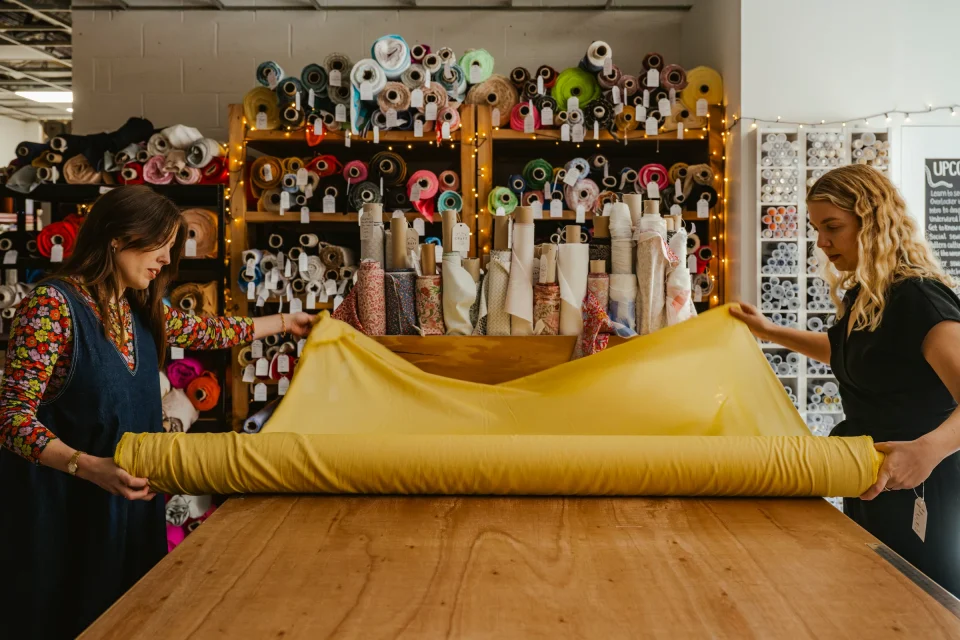
The creative process begins not with a blank sketchpad, but on the concrete floors of textile liquidators and dusty mill archives. A designer must physically handle the rolls, inspect the grain, test the drape, and assess the yardage. A thirty-meter bolt of double-faced wool requires an entirely different pattern architecture than an eighty-meter bolt of lightweight cotton poplin.
The Return of the Master Patternmaker
This structural reversal breathes life back into true atelier craftsmanship:
-
Adaptive cutting: Pattern pieces must be arranged like an intricate puzzle to maximize yield from irregularly sized cuts, reviving the meticulous cutting skills that automated mass-manufacturing made obsolete.
-
Embracing material quirks: Imperfections, localized color variations, or edge flaws cannot simply be rejected; they must be thoughtfully incorporated into the architecture of the piece or strategically avoided through clever seams.
-
Modular silhouettes: Designers must invent flexible construction methods that allow a single core silhouette to adapt across different fabric weights and rigidities.
Because machines calibrated for thousands of identical cuts cannot handle this level of nuance, deadstock requires human hands and continuous technical decision-making. The resulting garments carry an unmistakable sense of authorship. You can feel that someone thought through the exact placement of every dart, pocket, and lining to honor the cloth they were given.
Beyond Ethical Austerity: Sustainability Powered by Desire
Sustainable fashion historically suffered from an image problem. For years, the eco-conscious market was dominated by well-meaning brands selling shapeless garments in neutral earth tones made from organic linen or raw hemp. The messaging was heavily moralistic, urging consumers to buy less out of a sense of civic duty and environmental repentance.
The fundamental flaw in that strategy was forgetting that fashion is not an exercise in utility; it is an industry driven by desire, fantasy, and self-expression. People do not buy luxury garments because they want to feel responsible; they buy them because they want to feel extraordinary.
Deadstock sidesteps this trap by meeting luxury on its own terms. It does not ask the customer to compromise on drama, texture, or sophistication. In fact, surplus textiles often provide access to materials of vastly superior quality compared to what is commercially viable to weave today.
Decades ago, textile mills routinely wove fabrics with higher thread densities, richer dyes, and heavier natural fibers than modern economic pressures allow. Salvaged wools from the 1980s or vintage Japanese denims from discontinued looms often possess a structural integrity and depth of hand-feel that modern virgin alternatives cannot replicate without astronomical costs.
Deadstock transforms sustainable fashion from an exercise in self-denial into an exercise in connoisseurship. The environmental benefit—diverting thousands of yards of high-grade material from landfills without expending a single drop of water or chemical dye to manufacture new fiber—becomes a natural consequence of pursuing beauty, rather than the primary marketing lecture.
The Cultural Shift in Status Signaling
The rise of surplus luxury reflects a deeper evolution in how society communicates status through clothing. Conspicuous consumption, characterized by loud monograms and recognizable seasonal “it-items,” has become accessible to nearly anyone with credit and an internet connection. When high-status markers become ubiquitous, true exclusivity retreats into subtlety.
Wearing a deadstock garment communicates an entirely different set of values. It signals that the wearer values provenance over convenience. It suggests an appreciation for textile history, an eye for pattern construction, and a willingness to seek out independent artisans rather than walking into an airport duty-free boutique.
The story of the garment becomes its most intoxicating feature. There is immense social capital in being able to say that your tailored overcoat was cut from an overlooked cache of heavy cavalry twill originally woven for military uniforms sixty years ago, or that your silk dress came from the private surplus of a couture house that shuttered its doors in the nineties. The garment is no longer just clothing; it is a wearable archive.
The Scalability Paradox
The central tension facing deadstock fashion is the very thing that makes it valuable: it cannot scale.
For large fashion conglomerates whose business models depend on selling hundreds of thousands of identical units per quarter across global retail footprints, deadstock is an operational nightmare. It defies centralized procurement, breaks enterprise resource planning software, and makes standardized global inventory impossible.
A few mega-brands have attempted small-scale upcycling capsule collections, but these efforts almost always remain peripheral public relations initiatives rather than structural shifts. To make deadstock work, an organization must accept limits on growth. It demands smaller production runs, decentralized sourcing, and a direct-to-consumer or specialized boutique distribution model.
Yet, this inability to scale is precisely what preserves its magic. In a global economy obsessed with infinite scalability, frictionless commerce, and algorithmic ubiquity, deadstock fashion offers a defiant, beautiful alternative. It proves that the future of luxury does not belong to those who can extract the most virgin resources the fastest, but to those with the discernment, skill, and patience to turn the forgotten remnants of our past into the most coveted heirlooms of our future.
