
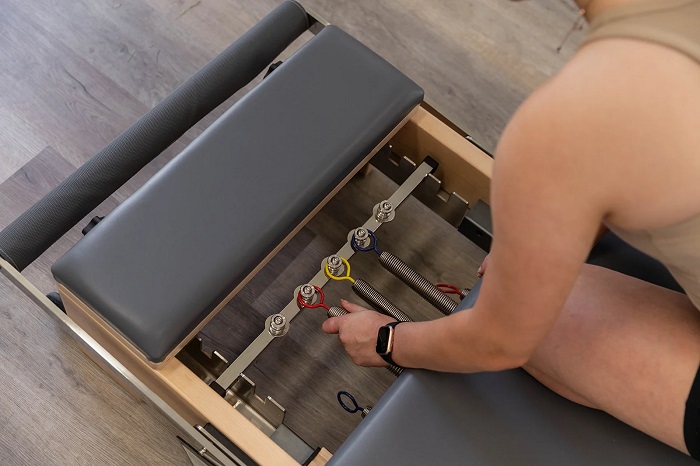
Adding spring tension is an obvious way to make a Reformer exercise feel harder. Slowing the movement can reveal a different type of difficulty. On a pilates reformer, deliberate tempo reduces momentum and gives participants more time to notice changes in carriage control, breathing and joint position.
Slower is not always better. The value comes from selecting a tempo that makes the intended movement clearer without turning every repetition into an unnecessarily prolonged endurance test.
Momentum Can Conceal Weak Points
A quick push may carry the carriage through the most challenging part of an exercise. The participant completes the range, but the muscles may not control every section equally.
When the movement slows, the carriage can no longer coast through those points. One leg may begin contributing more, the pelvis may shift or the participant may hold the breath.
These observations provide useful information. They show where the current spring, range or body position exceeds sustainable control.
Increasing spring tension without addressing the pattern may simply produce a faster, stronger compensation.
The Return Phase Often Reveals More
Participants frequently focus on moving the carriage away and treat the return as a reset. The springs assist that return, which means the participant must actively control the carriage as it moves towards the stopper.
A slower return can reveal whether control remains present throughout the range.
If the carriage accelerates suddenly near the end, the participant may need to reduce range, change springs or use a different body position.
Repeated impact at the stopper is not a useful marker of intensity. The return should remain deliberate enough that the next repetition begins from an organised position.
Tempo Changes Time Under Tension
A slower repetition keeps muscles working for longer, even when spring configuration remains unchanged. This can make a familiar setting feel substantially harder.
For example, a repetition might use three seconds to move out, a short pause and three seconds to return. The exact count is less important than consistency.
The participant should still be able to breathe and maintain the intended range. If the tempo becomes so slow that the body stiffens or technique deteriorates, the exercise has moved beyond its useful dose.
Tempo should serve control rather than create fatigue for its own sake.
Pauses Remove Automatic Movement
A short pause can confirm whether the participant genuinely controls a position. It removes the ability to bounce or reverse direction immediately.
Useful pause points may include:
- Before the carriage changes direction.
- At the end of a controlled leg extension.
- During a stable split stance.
- Before returning from arm work.
- At the point where pelvic control usually changes.
The participant should not relax completely into the equipment during the pause. The aim is to maintain the intended organisation without excessive bracing.
Slower Work Improves Instructor Observation
In a group class, fast repetitions can make subtle movement changes difficult to see. A slower tempo gives the instructor time to observe several participants and provide specific feedback.
It also allows the participant to process a cue during the repetition rather than waiting for the next set.
The class does not need to move in perfect synchronisation. Individual carriage ranges and tempos may vary slightly.
The important factor is that each participant understands the intended rhythm and can manage it safely.
Heavy Springs Can Sometimes Hide Control Problems
A high-tension setup may make the carriage feel stable. The participant can push forcefully without dealing with as much unwanted movement.
This can be useful when stability is the objective. It can also conceal whether the participant can manage the carriage with less assistance.
Slowing the exercise before changing springs provides a clearer comparison. If technique remains consistent at the slower tempo, additional tension may be appropriate.
If quality changes immediately, the existing load still offers room for progression.
Not Every Exercise Should Be Extremely Slow
Some Reformer exercises involve rhythm, coordination or preparation for faster movement. Excessively slow execution can change their purpose.
Slowing a transition may also increase fatigue in a position where the participant is not yet secure.
The instructor should decide whether the session is training control, endurance, power or coordination. Tempo needs to match that objective.
A varied programme may include slow technical repetitions and more fluid sections.
Use a Simple Tempo Progression
A practical progression can begin without complicated timing:
- Establish a comfortable natural speed.
- Make the return phase slower.
- Add a brief pause at the change of direction.
- Match the outward and return phases.
- Increase range only if the tempo remains controlled.
- Adjust springs after the movement quality becomes repeatable.
This process separates tempo progression from resistance progression.
Participants can focus on one change instead of trying to manage a new spring, larger range and slower cadence simultaneously.
Track Quality Alongside Cadence
A metronome or timer can help with consistency, but the number should not dominate attention.
After the exercise, participants can record whether both sides used a similar rhythm, whether breathing remained available and where speed changed.
A simple note such as “return accelerated during the final three repetitions” may be more useful than an exact average cadence.
Technology can document tempo, but it cannot decide whether the movement felt appropriate.
Use Slowness as a Diagnostic Training Tool
At Yoga Edition, participants can use controlled Reformer tempos to explore where movement quality changes before increasing spring tension.
Slower work makes weak points visible because momentum no longer carries the carriage through them. It also teaches the participant to manage the spring-assisted return.
Progress does not always need to appear as more resistance. A familiar spring setting performed with steady speed, clean pauses and controlled transitions can represent a substantial improvement. Tempo deserves attention before tension because it shows how well the existing load is truly being managed.
